

Hong Kong Real Estate Reversal? A Review of the Last 2 Months
- Coral King Ltd

- Jan 16
- 5 min read
Updated: Feb 3
Overview of the Current Market
Hong Kong’s property market entered 2026 with a selective and uneven recovery. This situation is shaped by liquidity conditions, policy signals, concentrated high-net-worth demand, and an intensified regulatory focus on building safety after the Tai Po tragedy. On 6 January 2026, Morgan Stanley upgraded the Hong Kong property sector to “attractive.” They projected a roughly 10 per cent rise in home prices in 2026. This endorsement amplified investor risk appetite for prime assets and property equities. However, it also highlighted the sensitivity of the outlook to changes in global financing conditions. The question of whether or not we will see a Hong Kong real estate reversal is becoming increasingly relevant.
Residential Market: Luxury Leads, Mass Market Lags
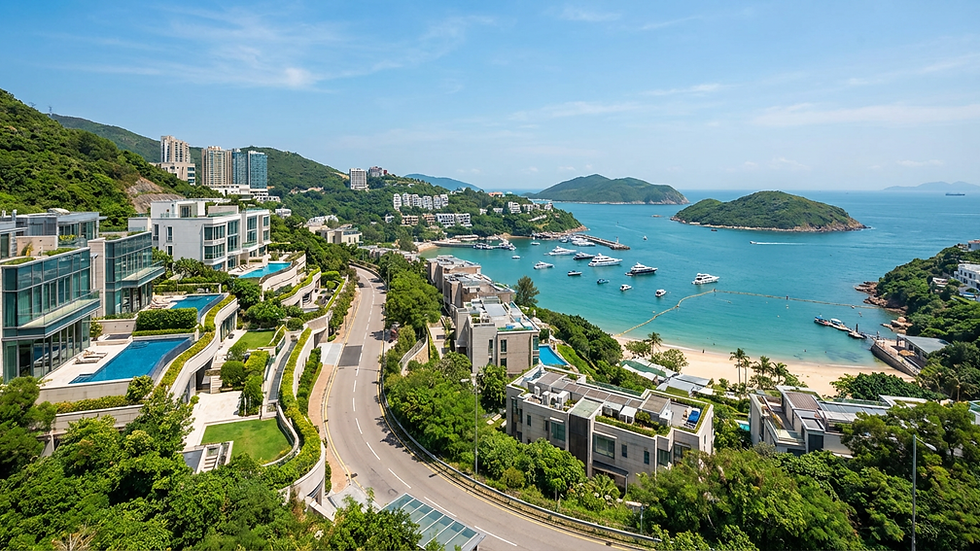
In the opening weeks of January 2026, the luxury segment showed disproportionate strength. Bloomberg reported around US$700–800 million of transactions at nine high-end projects around the new year. This included multi-hundred-million-dollar mansion sales by Swire Properties in Deep Water Bay and large detached-house deals by HKR International near Discovery Bay. High-value transactions at The Peak and the Southside reinforced the view that wealth-driven demand and selective mainland buyer activity are the engines of the early 2026 rebound.
This bifurcated dynamic has two practical economic consequences. First, the luxury-led cash flow improvement can materially strengthen balance sheets for developers that sold high-end stock. This improves their ability to fund staged launches or redeem near-term liabilities. Second, headline price gains concentrated in premium enclaves will not immediately alleviate affordability constraints in mid-market subsegments. The recovery remains shallow from a distributional perspective until demand broadens beyond high-net-worth buyers. Market participants should treat luxury transactions as a leading, not definitive, indicator of systemic recovery in the residential cycle.
Regional Consequences
The Southside (Deep Water Bay, Shouson Hill, The Peak) and island-east/Discovery Bay pockets have seen pricing and sales momentum. This could lift nearby prime rental and transaction benchmarks. In contrast, mass-market pressure points remain in older New Territories and certain Kowloon precincts where affordability gaps persist. Policy measures or a sustained improvement in mortgage conditions will be required to translate prime momentum into meaningful, broad-based demand.
Urban Renewal, URA Finance and Local Redevelopment
Public-sector renewal activity accelerated in early January. The Urban Renewal Authority (URA) successfully priced a dual-tranche HK$8 billion bond on 7 January 2026. This issuance was oversubscribed and will mainly fund capital expenditure on redevelopment projects. The transaction restores a funding channel for large-scale renewal projects and signals investor willingness to finance public redevelopment.
The URA’s financing capacity has direct supply-side implications for districts with aged building stock. Acceleration of schemes such as the Sai Yee Street / Flower Market Road acquisition implies potential medium-term conversion of low-grade tenement stock into higher-density mixed-use projects. This will eventually release new residential and retail supply but also require complex rehousing and compensation arrangements for affected households. The immediate economic effect is likely to be an increase in redevelopment tender activity and construction demand.
Economic Effects
The associated multiplier effects for contractor cash flows and building material prices are significant. However, short-run site works may be constrained by tighter safety oversight.
Tai Po Fire: Safety Enforcement, Cost Pass-Through and Insurance
The catastrophic fire at Wang Fuk Court in Tai Po in late November 2025 prompted a series of regulatory interventions that continued into January 2026. Preliminary investigations implicated combustible façade materials in the rapid vertical spread of the blaze. The government instituted citywide inspections of buildings undergoing façade maintenance and ordered the removal of flammable materials. These emergency measures have immediate economic ramifications. Owners’ corporations and property managers face higher compliance and capital expenditure requirements. Contractors confront more onerous certification and testing regimes. Insurers and lenders are likely to recalibrate underwriting and covenant conditions for renovation and refurbishment projects.
Collectively, these dynamics raise the marginal cost of maintenance and retrofit work for older stock. They can slow the rhythm of private redevelopment in the near term while improving safety and investor confidence longer term.
Land Supply, Tender Outcomes and Micro-Location Signals
The government’s January land-sale calendar provided early price discovery signals for Q1 2026 supply. On 9 January 2026, the Lands Department announced that Shau Kei Wan Inland Lot No. 860 would be offered by public tender from 16 January through 13 February. This small-to-medium inner-Hong Kong Island site is capable of delivering 7,286–12,142 square metres of private residential gross floor area under the conditions of sale. Tender results for such municipal sites will form a near-term barometer of developers’ willingness to commit equity to new supply.
Aggressive bidding would raise future launch prices in the eastern district. Conversely, tepid bids would confirm developer prudence and support a more cautious primary-market rollout.
Mainland Credit Stress and Spillover Channels
Credit stress in the mainland developer universe retains the potential to transmit to Hong Kong capital markets. On 7 January 2026, Reuters reported that China Vanke had secured lender approval to defer certain loan interest payments. This provides breathing room but attests to ongoing refinancing fragility. The direct economic channel is twofold: contagion to Hong Kong issuers’ bond yields and bank lending standards, and indirect sentiment effects that raise the risk premia demanded by investors for exposed credits.
Hong Kong-listed developers with strong balance-sheet metrics and diversified income will attract funding at a relative advantage. Those with concentrated exposure to mainland project value chains or heavy short-term maturities will see funding costs and access tighten.
Office and Retail: Spatially Differentiated Recovery
Commercial real-estate consultancies reported tentative stabilisation in prime office leasing in early January 2026. Take-up is concentrated in Central, Admiralty, and select parts of the island-east corridor. Secondary and peripheral office stock continues to face vacancy and tenant-mix pressure. Analysts emphasised a “flight-to-quality” effect where tenants consolidate into efficient, amenity-rich towers. This supports rental resilience in core submarkets even as aggregate demand remains constrained by hybrid working patterns.
The practical implication is a bifurcated office market. Premium CBD assets should see positive rental reversion and yield compression. In contrast, older B-and-C grade buildings, particularly in outlying Kowloon precincts, may experience longer leasing cycles and potential conversions to alternative uses if the differential persists. Retail recovery likewise remains segmented. Luxury shopping corridors that capture mainland high-net-worth visitor spend have outperformed high-street mass retail reliant on local household consumption.
Financing, Valuation and Investor Behaviour
The combined effect of these developments is a more discriminating capital market. Bond and loan investors are differentiating by covenant strength, leverage ratios, and earnings stability. REITs and well-managed income assets are attractive as yield plays if occupancy and tourist flows normalise. Developers with access to presale cash flows from luxury or phased projects can deleverage more quickly. Conversely, leveraged names or those with concentrated onshore liabilities will face steeper refinancing premia.
Short-Term Risks and Macroeconomic Sensitivities
The nascent 2026 upswing in Hong Kong property remains exposed to several tail risks. A global repricing of rate expectations could lead to higher mortgage costs. This would compress effective demand and dampen transaction volumes. A deterioration in mainland developer solvency, or a headline default by a prominent group, could tighten cross-border liquidity. Tender outcomes that reveal subdued bidding would indicate developer caution. Enforcement-driven construction stoppages and higher compliance costs following the Tai Po fire could compress margins and extend project schedules.
Conclusion: Selective Opportunity, Disciplined Underwriting
As of 16 January 2026, the market is best characterised as selectively opportunistic. Prime residential and central office assets show early signs of positive revaluation and improved take-up. This is supported by wealth effects, policy accommodation, and improved funding access for certain issuers. At the same time, structural vulnerabilities persist. These include mainland credit stress, an uneven supply pipeline, and heightened safety-related compliance costs.
Investors and banks should prioritise counterparty strength, cash flow resilience, and collateral quality. Developers should focus on phased launches, liquidity conservatism, and transparent communication of rehousing or safety remediation plans. Policymakers must balance safety and social fairness with measures that preserve orderly market functioning.


Comments